 Skip to content
Tools / SEO software review
Research before you subscribe
SE Ranking Review: Features, Pricing and Value for Money
A practical look at SE Ranking’s features, current costs and limitations, with a workflow for Kenyan businesses and a checklist to test before paying.
Affiliate disclosure: This article contains affiliate links. Social Scale Kenya may earn a commission if you purchase through them. Check the provider’s current price and terms before buying.
Our quick verdict
Give the platform a specific job.
Best reason to shortlist itYou have recurring research, audit and reporting work.
Best reason to waitNo one has capacity to implement the findings.
How we assessed itOfficial product documentation and pricing. No claimed hands-on benchmark.
IN THIS REVIEW
- What it does
- Who it suits
- Features
- Pricing and costs
- Pros and limitations
- Kenyan property workflow
- Trial checklist
- Comparing alternatives
- Common questions
- Our verdict
Test your own workflow before making an annual commitment.
Is SE Ranking worth paying for?
Potentially, if you have ongoing SEO work and someone to act on the findings. Our view is to evaluate it on one real website before committing. The most useful result of a trial is a better set of decisions, not a higher dashboard score.
What SE Ranking Does for Your Website and SEO Workflow
SE Ranking is a subscription platform that brings several SEO tasks into one workspace: researching search demand, checking competitors, tracking rankings, inspecting website problems and reporting progress. Its product range also includes content and AI search visibility tools. These capabilities are useful when someone has responsibility for improving a website over time.
The buying question is straightforward: will the information change what you do next? A dashboard becomes valuable when it helps you choose a page to improve, identify a technical problem or explain why a campaign needs a different approach. Opening reports without acting on them creates another monthly expense.
For a Kenyan estate agency, that could mean deciding whether to improve an existing Westlands property page or publish a new neighbourhood guide. For a freelancer, it could mean using a consistent process across client websites. Neither situation requires you to use every feature.
Source: SE Ranking product overview.
Who Should Consider SE Ranking and Who Should Wait
| Your situation | Our buying recommendation |
|---|---|
| You manage SEO for several clients | Shortlist it if a shared research, audit and reporting process would reduce repeated work. |
| Your business already maintains a useful website | Trial it against a defined backlog of pages, keywords and technical issues. |
| You publish commercially focused articles regularly | Test whether its research improves topic selection and page briefs. |
| You only need an occasional check | Start with free tools and a manual review before adding a subscription. |
| You need immediate sales and have no SEO capacity | Prioritise a working offer, follow-up and the channel that can reach buyers now. |
These are editorial recommendations, not measured performance claims. Our strongest reason to shortlist SE Ranking is the combination of connected tasks. Our strongest reason to postpone it is the absence of someone who can implement the findings.
If you are still comparing software categories, read our guide to choosing marketing tools worth paying for before building a stack. Buying a research platform and buying a video editor solve different problems.
SE Ranking Features That Matter in Everyday SEO Work
Keyword research: turn search terms into page decisions
The Keyword Research tool provides suggestions alongside metrics such as search volume, difficulty, intent, trends and cost per click. It also shows search results, giving you a way to inspect what currently ranks. Treat the numbers as estimates and the difficulty metric as a screening aid.
Our suggested approach is to begin with a service or property type, then narrow it by location and customer need. A term such as “apartments for sale in Kilimani” suggests a different page from “cost of buying an apartment in Kenya.” One visitor may want available units; the other may need help understanding the purchase process.
Those examples are proposed seed terms, not keywords we have measured in this review. Check their demand and live search results before choosing them. A low-volume phrase can still be commercially relevant, while a popular phrase may attract the wrong audience.
Source: Keyword Research features.
Rank tracking: monitor a defined set of searches
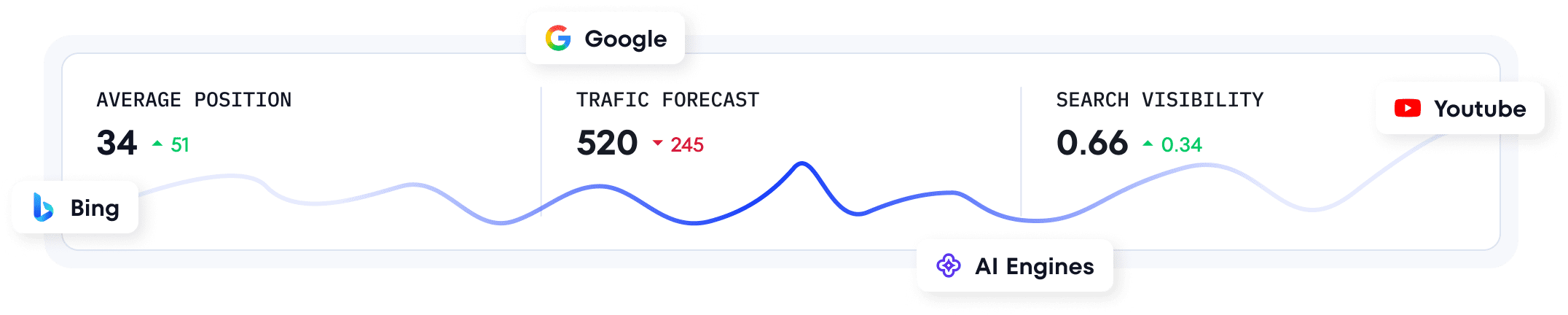
SE Ranking describes daily position tracking across Google, Bing and YouTube, with desktop and mobile options. Kenya appears in its rank checker’s country selection. Confirm the exact location and search-engine settings you need during the trial, especially if you require a particular town or neighbourhood.
Build a modest starting list around priority pages. Separate branded searches from searches for your service, and separate locations where your offer differs. Track the destination URL as well as the position. If the wrong page ranks, your next task may be to improve page targeting rather than publish another article.
Review trends over several weeks alongside enquiries and page changes. A single movement does not establish that a campaign succeeded or failed. Ranking information is most useful when you can connect it to a specific action.
Source: Rank Tracker and supported country selection.
Website Audit: build a prioritised repair list
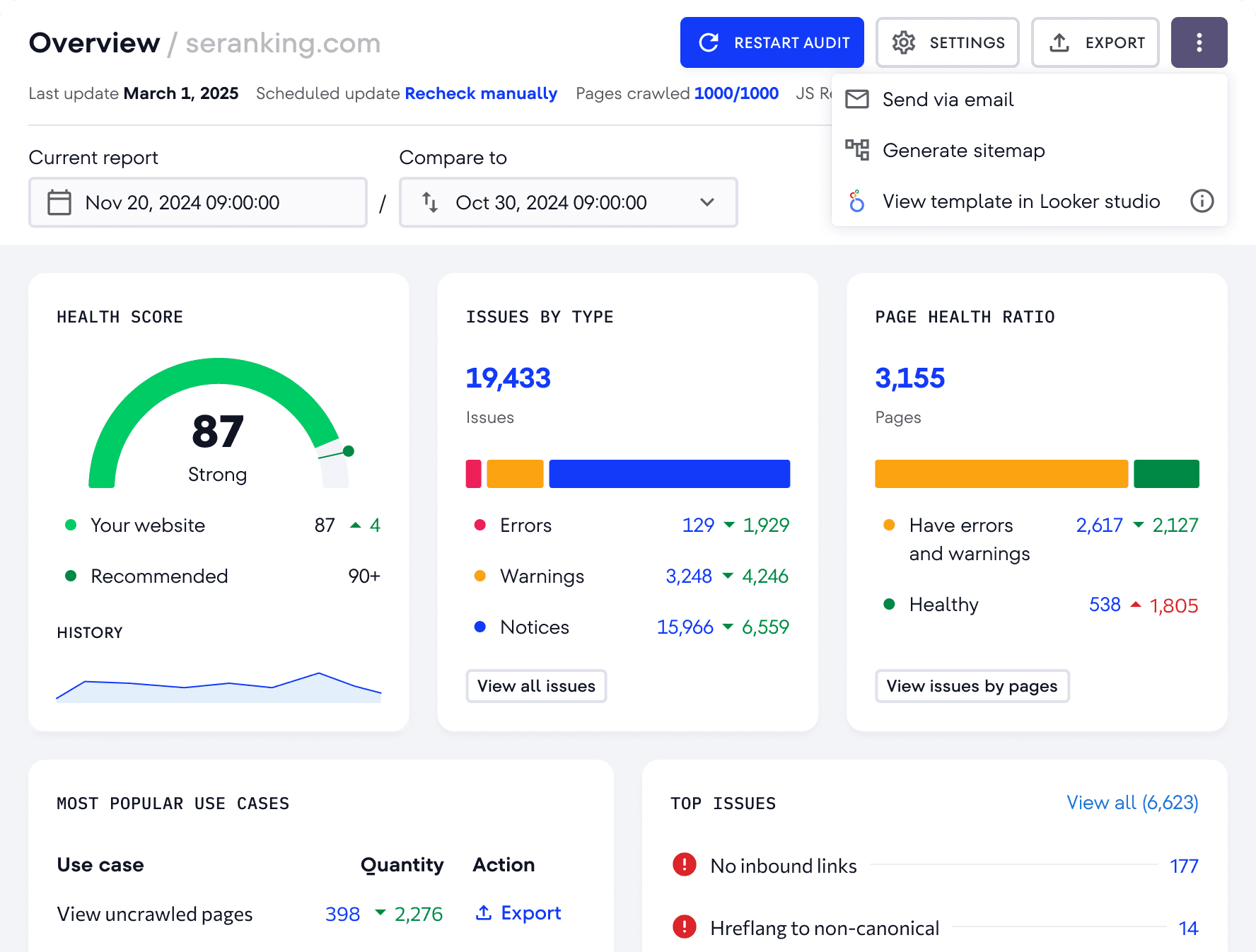
Website Audit crawls a site and organises technical findings into reports. The provider documents scheduled crawls, detailed issue inspection, crawl comparisons and optional JavaScript rendering. Its issue breakdown can help organise a repair backlog, but a health score is not a revenue measure.
For a property website, our suggested first pass is to inspect broken internal links, important pages that cannot be reached reliably, duplicate versions of key URLs and images that make listing pages cumbersome. Verify each finding before editing. Some URLs should remain excluded from search, and some old listings should have a considered replacement or archive strategy.
Prioritise problems that obstruct a useful customer journey: an unavailable page linked from a development guide deserves attention before a minor cosmetic warning. Record the affected URL, the proposed fix, the person responsible and the result of a follow-up check.
Source: Website Audit capabilities.
Competitor research: investigate the pages winning attention
The competitor research tool surfaces search keywords, estimated traffic and information about competing pages and paid search activity. That can help you identify websites competing for the same searches, including publishers and property portals that are not direct business rivals.
Use the findings to investigate the page itself. Does it answer a buying question clearly? Does it explain the location, price basis or selection process? Is it easier to navigate? A traffic estimate can point you towards a useful comparison, but it cannot reveal a competitor’s actual enquiries, customer quality or profit.
Our recommendation is to build a gap list around unanswered customer questions. Copying a competitor’s headings without providing better evidence rarely gives a visitor a reason to choose your page.
Source: Competitor Research features.
Backlink analysis: inspect relevant sources of authority
Backlink Checker reports links and referring domains, with information such as target pages, anchor text, link type and status. It can support an investigation into how relevant websites earn mentions.
For a property business, use that research to identify credible opportunities such as local reporting, professional directories with real readership, relevant associations or useful research that journalists could cite. Judge each opportunity by its audience and editorial relevance.
A large link count is not a sufficient buying reason. Do not turn an authority metric into a target that encourages irrelevant placements. The useful question is whether a credible source has a good reason to reference your business or resource.
Source: Backlink Checker features.
Content tools: improve briefs while keeping editorial control
SE Ranking’s content offering includes a Content Editor and AI Writer. The provider describes search-result-based briefing guidance, suggestions for structure and terms, and AI-assisted drafting.
Use those suggestions as prompts for an editor. A real estate article still needs verified prices, accurate locations, current availability and clear explanations of what a buyer should check. A software-generated draft cannot supply missing first-hand evidence about a development.
A sensible brief identifies the audience, the decision the page supports, the questions it must answer and the evidence required. Review optimisation suggestions against that brief. Adding an unrelated phrase to raise a score can make the article less useful.
Source: Content Marketing tools.
AI visibility and local tools: test coverage before buying
The AI visibility product describes tracking brand mentions and cited pages across services including ChatGPT, Google AI Overviews, AI Mode and Gemini. Its usefulness depends on whether the queries, locations and engines you need are available within your plan.
Our suggested test is to select a few buyer questions and inspect the answers and sources repeatedly. Treat the findings as a sample of visibility, not a complete account of every response every customer receives. An AI mention is a research signal; its commercial value still needs to be assessed.
Source: AI visibility tracking.
SE Ranking also markets local ranking, listing and review management tools. Check Kenyan directory coverage, your exact address and feature availability before treating local marketing as a reason to subscribe. Broad international coverage does not establish that every local service you need is supported.
Source: Local Marketing features.
SE Ranking Pricing, Billing Terms and Extra Costs to Check
Pricing checked: 19 October 2026. The live page lists Core, Growth and custom Enterprise plans. USD prices below distinguish monthly billing from the monthly equivalent of annual billing.
| Plan | Monthly billing | Annual monthly equivalent | Selected allowances |
|---|---|---|---|
| Core | $129 | $103.20 | 10 projects; 1 manager; 2,000 daily tracked keywords; 250,000 audit pages/month |
| Growth | $279 | $223.20 | 30 projects; 3 managers; 5,000 daily tracked keywords; 2 million audit pages/month |
| Enterprise | Custom | Custom | Limits and terms agreed with sales |
Annual subscriptions are billed upfront. Core therefore totals $1,238.40 per year; Growth totals $2,678.40, before applicable extras or taxes. The advertised trial lasts 14 days with no credit card required, and has lower usage allowances than the paid plans.
The pricing page lists Agency Pack at +$69/month on annual billing. Additional AI Search capacity starts at +$89/month or +$71.20/month with annual billing. Check your exact configuration, included features and checkout total. Cancellation does not normally mean a refund.
Source: Current plans, add-ons and billing FAQ.
Read older pricing articles carefully
Do not budget from an old review or a promotional screenshot. Open the current checkout and record the plan name, commitment, amount due today and renewal conditions. Keep a copy of the quotation if you are buying for a client.
For a Kenyan buyer, budget in the currency your card will actually be charged and include the conversion rate and fees applied by your payment provider. We have deliberately avoided a fixed shilling conversion that could misrepresent your eventual cost.
Our purchasing view: use the trial to decide whether the workflow earns its place, then choose a billing commitment you can sustain. An annual discount is useful only when continued use is already justified. Compare time saved and decisions improved against the full expense, including the work needed to act on reports.
SE Ranking Pros, Limitations and the Practical Tradeoffs
| Why it deserves a shortlist | What deserves caution |
|---|---|
| Several recurring SEO tasks share one platform | A small business may use too little of the platform to justify its subscription. |
| Research can lead into tracking and an audit backlog | Findings still require writing, development or marketing work. |
| Project limits make capacity planning more concrete | Seats, extra capacity and agency requirements can change the full bill. |
| A trial lets you test an actual website | A short trial cannot prove long-term ranking or revenue improvement. |
| AI and local capabilities broaden the scope | Coverage and allowances need checking against the exact market and use case. |
These tradeoffs are our assessment of the documented product and buying situation. We have not conducted a controlled accuracy benchmark, measured support response times or compared identical projects across paid accounts. We therefore do not assign an invented star rating or claim it is the most accurate SEO tool.
The biggest practical limitation is the implementation gap. A report can identify an opportunity, but someone must still improve the page, repair the website or create the resource. Include that responsibility in your buying decision.
How a Kenyan Property Business Could Use SE Ranking
Consider a hypothetical agency selling apartments in Westlands and Kilimani. It has a website, some development pages and a steady supply of customer questions, but no reliable process for choosing SEO work. This is a proposed workflow, not a client case study or a promise of results.
1. Define the enquiry the website should attract
Write down the buyer type, locations served, price range and next step. A page aimed at investors researching rental potential needs different evidence from a page aimed at a family comparing homes. Define what counts as a qualified enquiry so that traffic growth has a business meaning.
2. Audit the pages closest to that enquiry
Begin with the main service pages, location pages and active development pages. Check whether the pages work, whether the content is current and whether a visitor can request a viewing easily. Put the first five meaningful repairs into a task list before collecting hundreds more findings.
3. Research a small, commercially useful topic set
Try seed searches such as “apartments for sale in Westlands,” “Kilimani apartment service charges” and “off-plan apartment buying process Kenya.” Inspect results and available local data. These are research ideas, not validated search-volume claims. Use customer conversations to decide which questions deserve priority.
4. Match one clear purpose to each important page
Avoid sending every searcher to the homepage. A location guide can explain transport, amenities and tradeoffs; a development page can explain the specific project and verified commercial details. Link related pages where that helps a visitor continue their research.
For the page-level work, use our property listing SEO guide. Broader channel planning belongs in our real estate digital marketing guide.
5. Measure page changes alongside business outcomes
Log publication and repair dates. Review priority rankings, search clicks where available and qualified enquiries. Track viewing requests, completed viewings and sales separately. A rise in ranking is encouraging only to the extent that it contributes to the audience and outcomes you defined.
A monthly review should end with decisions: which page to improve, which question to answer next, which problem to fix and which task to stop doing. That is the operating rhythm a subscription should support.
A Practical Trial Checklist Before You Pay for SE Ranking
Use the trial as a work sample. Set a decision date before starting, and choose one website you can inspect and improve. The schedule below is our suggested evaluation process; it does not imply that SEO results can be proved in two weeks.
| When | Work to complete | Evidence to keep |
|---|---|---|
| Days 1 to 2 | Set up the website and required location/device settings. Check access and quotas. | A documented configuration that matches the target market. |
| Days 3 to 4 | Run an audit and manually verify five meaningful findings. | A short repair list with working URLs and owners. |
| Days 5 to 7 | Research a topic and inspect competing pages. | A prioritised keyword list and a useful page brief. |
| Days 8 to 10 | Track priority searches and produce a report you would actually use. | A readable baseline and a repeatable reporting format. |
| Days 11 to 14 | Review gaps, required extras, implementation time and total cost. | A written buy, postpone or decline decision. |
- Can you research and track the locations and searches that matter to your customers?
- Does the audit reveal issues you can verify and resolve?
- Can you turn the research into a better brief or page decision?
- Are the report, permissions and export options sufficient for your work?
- Does the full subscription cost fit the workload you will realistically maintain?
If the answer is uncertain, write down the missing requirement and ask support a specific question. For example: “Can I track this device, search engine and Kenyan location within this plan?” is more useful than “Is your tool good for my business?”
How to Compare SE Ranking with Other SEO Tool Choices
The fairest comparison starts with the same task, website, keyword sample and budget. Comparing one vendor’s cheapest plan with another vendor’s broader package can produce a misleading result. If you are also considering Semrush, Ahrefs or another suite, compare the exact plans against your required outputs.
| Requirement | Comparison test |
|---|---|
| Local relevance | Use identical Kenyan seed terms and inspect the coverage and live results. |
| Ranking workflow | Configure the same search engine, location, device and keyword list. |
| Technical audits | Manually verify the issues that would change your implementation plan. |
| Competitor research | Review whether the surfaced pages and opportunities are relevant to your business. |
| Reporting and access | Create the report your client or manager needs, with the required permissions. |
| Cost | Compare the full commitment, extras, renewal terms and realistic workload. |
Free search and website measurement tools may be enough when you have one small website and only occasional research needs. Google Search Console is a sensible starting point for understanding your own site’s search performance; consult its official documentation for scope and setup. A paid suite should solve a recurring gap you can name.
Google’s Search Console introduction explains the first-party tool. Our recommendation is to establish a measurement habit before paying for greater research capacity.
SE Ranking Questions to Resolve Before You Subscribe
Is SE Ranking a lifetime purchase?
The current offer is subscription based. Distinguish the monthly price from the annual commitment before paying, and check any special promotion against its own written terms.
Can SE Ranking help a business in Kenya?
It is worth evaluating for Kenyan SEO work, but test the exact keywords, locations, devices and data coverage you need. Availability of a country option alone does not prove that every local query or feature has sufficient coverage.
Will subscribing improve my Google ranking automatically?
No. You still need to act on relevant findings, maintain useful content and improve the website. This review does not promise a position, traffic increase, sales volume or return on investment.
Does it replace an SEO specialist or marketing agency?
It supplies research and monitoring capabilities. The need for specialist help depends on who can interpret the findings and implement the work. Assign those responsibilities before subscribing.
Should a beginner buy it immediately?
Start with a website, a defined audience and a short list of tasks. Use the trial to test whether the platform helps complete them. Postpone the subscription if you cannot explain what you will use it for each week.
Does Social Scale Kenya earn from these links?
We may earn a commission if you purchase through a marked affiliate link. Our recommendations include reasons to postpone buying, and the provider controls prices, eligibility and billing terms.
Our SE Ranking Verdict and the Best Next Step for You
SE Ranking deserves a place on the shortlist for marketers and businesses doing recurring SEO work across research, technical reviews and reporting. Its value depends on how often those tasks occur and whether the resulting work gets implemented.
Our recommendation is to test a real project before committing. Choose it if the platform helps you make better page decisions, maintain a clear repair backlog and report progress at a sustainable cost. Wait if your website lacks a clear offer, your budget cannot support implementation or your immediate problem lies elsewhere.
Put one real website through the trial
Bring a priority page, a short keyword list and five questions you need answered. Use the results to make a purchase decision with a clear purpose.
Need help connecting website visibility to enquiries? Explore Social Scale Kenya’s property marketing services. You can also return to the Tools hub for more buying guidance.
Editorial method: This is a researched product review based on the provider’s public feature pages and live subscription page, checked on 19 October 2026. Buying recommendations, examples and evaluation steps are Social Scale Kenya’s editorial analysis. The examples are hypothetical. We have not tested a paid account for this article or verified performance claims through a controlled study.
Sources: Official feature pages are linked beside the relevant sections. Product images are supplied by SE Ranking and show sample data. Features, availability, limits and prices can change. Affiliate relationships do not establish a tool’s suitability for your business.


One response to “SE Ranking Review: Features, Pricing and Value for Money”
[…] is also different from an SEO tool. Our SE Ranking review covers a separate set of tasks around search visibility. Neither subscription should be added […]